


[3D Printing Application] Polymaker & XEV jointly create a 3D-printed electric vehicle - LSEV
March 11, 2018 - Italian electric vehicle company XEV and 3D printing material company Polymaker held a press conference at the China 3D Printing Culture Museum in Shanghai to announce and showcase the world's first mass-producible 3D-printed electric vehicle to the public.
While the new car has garnered much attention, this launch event was not just about showcasing the vehicle; it also revealed how 3D printing technology will revolutionize the automotive industry.
This model, named LSEV, will be a milestone product in the application of 3D printing to mainstream production. XEV is the first mass-production project completed entirely using 3D printing.
Dr. Luo Xiaofan, co-founder and CEO of Polymaker, explained that although many other companies use 3D printing for production, none can compare with XEV in terms of size, scale, and strength.

XEV CEO Stanley said, "After conducting research on the global automotive market, they decided to design a product that could achieve C2M (customer-to-manufacturer)."
The manufacture of small electric vehicles is described as a key objective of the Industry 4.0 strategy. 
To achieve this goal, it requires large-scale custom manufacturing, rapid and cost-effective research and development, and the ability to produce lightweight parts that improve fuel efficiency. "Therefore, 3D printing technology becomes the only way to achieve this goal," Stanley said.
While there are many challenges in using 3D printing technology in automated production, Polymaker was fortunate to be selected as a strategic partner and successfully helped XEV solve these problems, including not only material solutions but also after-processing options consistent with the automotive industry. 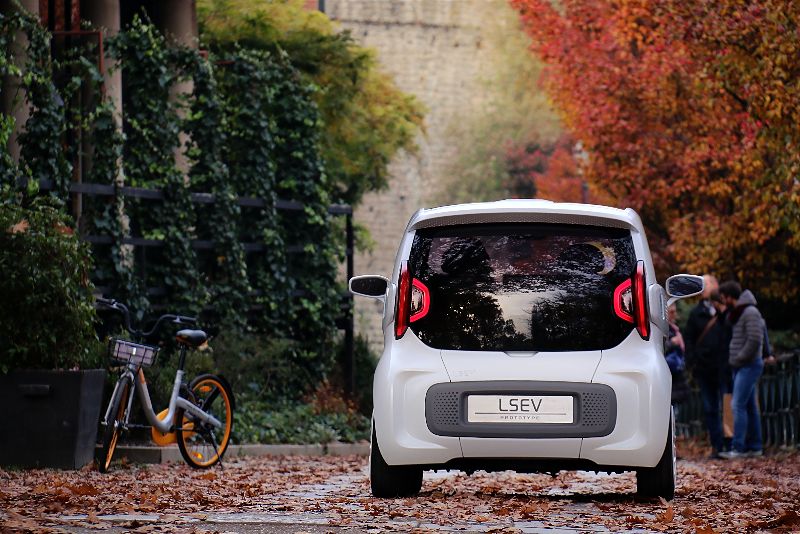
Polymaker developed dozens of engineering plastics for XEV to meet their practical application needs. Ultimately, they achieved three major successes. These are:
1. The XEV reduces the number of plastic parts in the car from more than 2,000 to 57, and the finished LSEV weighs only 450 kg, far less than similar vehicles that typically weigh between 1 and 1.2 tons.
2. Apart from the chassis, seats, and glass, all visible parts of the car are 3D printed using Polymaker materials.
Compared to traditional production systems, this production conversion method reduces investment costs by more than 70%.
3. The development process of traditional car models takes about 3 to 5 years, but the new design of XEV can be completed in only 3 to 12 months.

Polymaker also offers solutions for surface treatment and coloring. These solutions are highly effective for custom production and mass production of 3D printing.
Before mass production, XEV had already received 7,000 orders from Europe.
5,000 orders came from the Italian post office. Another 2,000 orders came from ARVAL, a car rental company owned by the French wholesale bank BNP Paribas. The XEV program will...
Production began in the second quarter of 2019.
The strategic partnership between XEV and Polymaker will bring about a revolutionary change in the automotive industry.
Similar changes related to 3D printing technology may soon occur in all aspects of manufacturing. This is because Polymaker has proven that their 3D printing materials are suitable not only for end-use parts but also for mass-producing finished products.

The following is an in-depth interview with Stanley, CEO of XEV.
The main purpose of designing this car
I'm a car maker, and I've been doing it for 20 years. Over the past 20 years, the process of manufacturing and researching cars has been extremely complex and painful.
So we were constantly looking for a solution to free ourselves from this complex, painful, and expensive process. Ultimately, we discovered that 3D printing was the only solution, the only way out. 3D printing allows us to reduce development costs by 90% and development time by 70%. Cars will be more aesthetically pleasing because they transcend the limitations of traditional manufacturing, allowing for greater freedom in design style and creativity, and more variations. Simultaneously, it allows for faster production times.
Create a wide range of production lines. Each production line will target the customer's niche market.
3D printing was chosen for the final production process.
We called 3D printing "rapid prototyping" many years ago. We have always used rapid prototyping to develop parts.
In the past, we learned about SLA, then SLS, and later FDM. A few years ago, FDM became very popular, and many FDM 3D printers appeared.
It gave me an insight: FDM technology and materials are affordable for the general public, and 3D printing can be used for mass production. Then I started looking for ways to achieve this. During this time, I found my partner, Roberto, one of the best 3D printing experts. Then I found Mr. Luo Xiaofan, the founder of Polymaker, who created the best 3D printing materials for us. Two years ago, we all brainstormed how to use FDM technology for mass production. Finally, we created a 3D printing production line. It combines all the advantages of 3D printing and is more affordable than traditional manufacturing.
Lower cost.
The time required to print all the plastic parts of an LSEV car
Currently, it takes approximately three days to print all the cars, from the inside out. Each of our 3D printers can extrude 25 kg of material per day.
It is about 10 times larger than other industrial 3D printers.
Challenges of scaling up production
The biggest challenge is that no one has ever done this before. So, we must bravely try it ourselves, but we believe in our best talent and that we will find the best method in the shortest amount of time.
What other benefits does 3D printing bring to the manufacturing process?
3D printing offers many benefits. It allows us to create more freely.
Not only our customers, but even the general public can participate in car development. This also changes the way cars are manufactured industrially. The cost of building factories has become lower.
We are creating the most efficient production methods, not just for automobiles, but for other projects as well. We will build a platform that allows a single machine to construct an infinite number of shapes and an infinite number of parts.
You don't need to change machines to manufacture different parts. With just one machine, you can make car doors or bumpers, round or triangular.
Parts with an area of 0.5 x 0.5 meters or 1.5 x 1.5 meters.
Therefore, anyone can make any kind of contribution to this manufacturing platform. The only thing that needs to be changed is the 3D data.
You don't need to know how to make a car; you just need to design the look you like. Then, the manufacturing process is handled by a 3D printer. That's my idea for Industry 4.0.
Help from Polymaker
Without Polymaker, we couldn't do this. The automotive industry has extremely demanding requirements, because you might need to drive a car from 40°C to -30°C.
Another location. Therefore, this project has very difficult requirements in terms of materials.
We thoroughly enjoy our interactions with Polymaker, which can be described as a fusion of knowledge. Without these interactions, we wouldn't have found our current solutions. Therefore, we are very grateful for Polymaker's efforts and creations; we are like brothers, not just strategic partners. 
Original source:
http://www.polymaker.com/polymaker-xev-launch-3d-printed-electric-car-lsev/
[3D Printing Application] Polymaker & XEV Join Forces to Create 3D Printed Electric Vehicles
3DMART |