


[3D Printing] Bambu Lab's new "Trust Center" lists everything it does to protect 3D printers.
In an industry that is usually tight-lipped about security issues, Bambu Lab has finally released its full set of guidelines.
Here's what this new transparency means for you and all other 3D printer users.
Here's what this new transparency means for you and all other 3D printer users.
Bambu Lab, headquartered in China, is taking an extremely transparent approach to addressing data security and privacy issues with desktop 3D printers: a brand-new online "trust center".
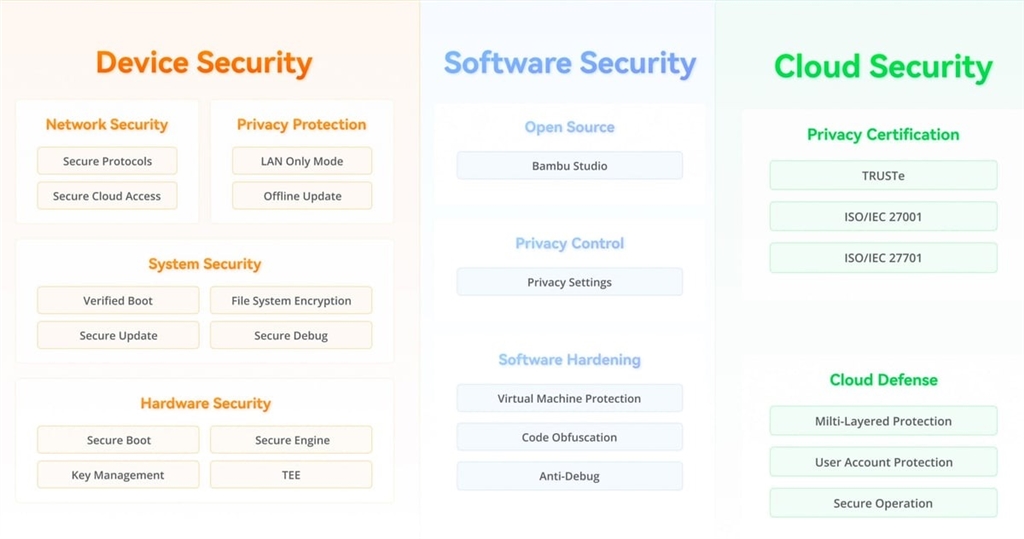
This public center provides a comprehensive overview of Bambu Lab's security architecture—from hardware-level encryption to third-party data storage—although not all measures are enabled on every printer.
While other professional consumer 3D printer manufacturers have also implemented security protocols, they rarely disclose them publicly.
Bambu Lab's approach sets a new benchmark.
By publicly detailing its measures, obtaining ISO and TRUSTe certifications, and providing user-centric, granular privacy controls, the company is enhancing security and transparency across the 3D printing market.
As we discussed in our news article a few days ago, " Is Your 3D Printer at Risk ? You Might Be Surprised," security has become a hot topic in the desktop 3D printer industry. This isn't because of a surge in new 3D printer hacks (currently), but rather because industries already suffering from persistent desktop computer attacks (such as aerospace, defense, and large multinational corporations) are facing similar challenges.
These users want their machines to have stronger security, especially when they are on the company network.
"Users should know exactly how their printers and data are protected," said Tao Ye, CEO of Bambu Lab.
"The Trust Center has been unveiled. We are making our security practices, certifications, and ongoing efforts completely transparent so that users can make informed decisions about their devices."
Hardware security as a foundation
These features may be too detailed for most consumer users.
Bambu Lab has these security features, but they've never been described in such detail before.
Most notably, your Bambu Lab 3D printer (depending on the model) has security features that are largely the same as your mobile phone or laptop, with all customer data outside of China stored on Amazon Web Services servers located in the United States.
The 38-page security development white paper published by Bambu Lab does not use generic terms, but instead details specific enterprise-level security technologies at both the hardware and software levels.
The white paper also reveals how your data will be used, by whom, and how to contact the company to request data deletion.
In its white paper, Bambu Lab stated, "We firmly believe that only by fully respecting and protecting user data security and privacy can we win users' lasting trust."
We will continue to increase our investment in this area, collaborate with the security community in an open and cooperative manner to improve the security of our products and services, and listen to user feedback with respect.
These features may be too detailed for most consumer users.
Bambu Lab has these security features, but they've never been described in such detail before.
Most notably, your Bambu Lab 3D printer (depending on the model) has security features that are largely the same as your mobile phone or laptop, with all customer data outside of China stored on Amazon Web Services servers located in the United States.
The 38-page security development white paper published by Bambu Lab does not use generic terms, but instead details specific enterprise-level security technologies at both the hardware and software levels.
The white paper also reveals how your data will be used, by whom, and how to contact the company to request data deletion.
In its white paper, Bambu Lab stated, "We firmly believe that only by fully respecting and protecting user data security and privacy can we win users' lasting trust."
We will continue to increase our investment in this area, collaborate with the security community in an open and cooperative manner to improve the security of our products and services, and listen to user feedback with respect.

Software security
The most important aspect of this publication is its focus on security built directly into the silicon chip, a practice common in smartphones and enterprise devices but less so in consumer-grade 3D printers.
Trusted Execution Environment (TEE): The X1 and H2 series printers utilize ARM TrustZone technology, which is a key differentiator between them and other desktop FDM 3D printers.
This technology creates a hardware-isolated "secure world" on the processor for handling the most sensitive operations, such as key management and firmware decryption.
This ensures that even if the main operating system is threatened, the printer's most critical security functions remain protected.
Secure Boot and Verified Boot: All Bambu Lab printers support Secure Boot, which uses a hardware "root of trust" to verify the authenticity of the printer software one by one from the moment the printer is powered on.
The advanced X and H series also added a verification boot feature to check whether the file system has been tampered with.
This is crucial for preventing the installation of persistent malware or unauthorized firmware.
Encrypting storage using hardware keys: Storage is encrypted using keys protected by the hardware itself.
In the P1 and A1 series, the key is stored in Efuse, so only the hardware security engine can read it.
This prevents attackers from physically removing the storage chip and reading the data within it.
The most important aspect of this publication is its focus on security built directly into the silicon chip, a practice common in smartphones and enterprise devices but less so in consumer-grade 3D printers.
Trusted Execution Environment (TEE): The X1 and H2 series printers utilize ARM TrustZone technology, which is a key differentiator between them and other desktop FDM 3D printers.
This technology creates a hardware-isolated "secure world" on the processor for handling the most sensitive operations, such as key management and firmware decryption.
This ensures that even if the main operating system is threatened, the printer's most critical security functions remain protected.
Secure Boot and Verified Boot: All Bambu Lab printers support Secure Boot, which uses a hardware "root of trust" to verify the authenticity of the printer software one by one from the moment the printer is powered on.
The advanced X and H series also added a verification boot feature to check whether the file system has been tampered with.
This is crucial for preventing the installation of persistent malware or unauthorized firmware.
Encrypting storage using hardware keys: Storage is encrypted using keys protected by the hardware itself.
In the P1 and A1 series, the key is stored in Efuse, so only the hardware security engine can read it.
This prevents attackers from physically removing the storage chip and reading the data within it.
High-level system and kernel enhancement
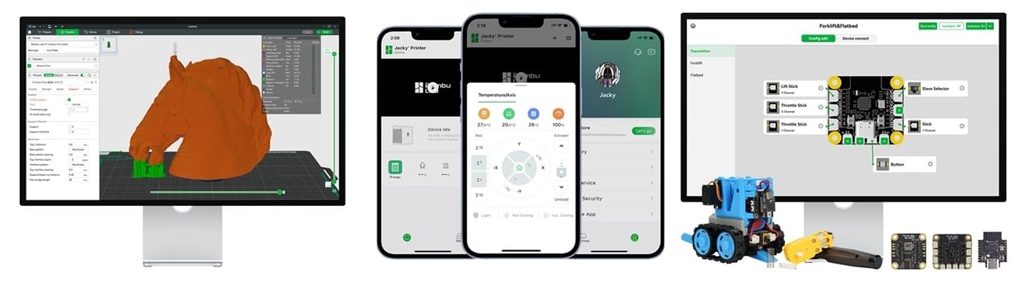
In addition to hardware, Bambu Lab also detailed specific, advanced software defense measures to protect the printer's operating system during runtime.
Enforced Access Control (MAC): On higher-end models (currently H2C, planned for all X/H2 series), AppArmor is used to restrict applications to a strict set of rules, thereby limiting the potential damage caused by exploited applications.
Kernel Randomization (KASLR): This feature is also used in high-end models. It randomizes the location of the kernel software in memory each time the printer starts up.
This makes it more difficult for attackers to carry out common vulnerability attacks that rely on knowing the precise location of the core in memory.
Direct privacy control for users
Despite all the security measures mentioned above, the most secure 3D printer is still one that does not communicate at all.
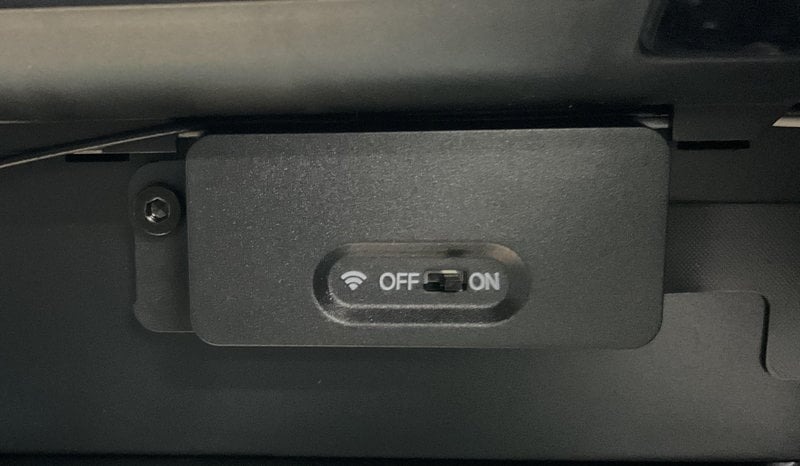
Bambu Lab X1E and H2C are equipped with a physical network switch that can completely disconnect the machine from the local network and Wi-Fi network.
LAN-only mode: Some Bambu Lab printers (X1E and the upcoming H2C) offer a "LAN-only mode" in which the printer does not initiate any external connections and all communication is conducted securely on the local network.
This directly serves users who have strict requirements for privacy or security.
Offline updates: Crucially, the company provides a method for secure firmware updates using an SD card for users in LAN-only mode. This allows users to access new features and security patches completely offline.
Print Farm Developer Mode: In response to feedback from business users, Bambu Lab has added a "Developer Mode" to the "LAN Only" mode.
This allows common third-party management software used in print farms to bypass certain new authorization controls and continue to operate normally, demonstrating its willingness to actively adapt to the needs of professional users.
Independent certification obtained
Bambu Lab also announced that, following extensive third-party audits, it received three internationally recognized certifications in 2025.
ISO/IEC 27001 (Information Security Management): This standard was certified on April 11, 2025, confirming that the company meets the stringent international requirements for protecting information assets.
ISO/IEC 27701 (Privacy Information Management): Also certified on April 11, 2025, demonstrating alignment with the global privacy protection framework.
TRUSTe Enterprise Privacy: Certified in July 2025, indicating that the company's privacy management system complies with established international standards.
Find the Bambu Lab vulnerability and win a bounty.
The company's ongoing security efforts include a bug bounty program that has been active since 2023.
To date, 51 security researchers have participated in the program to help identify and resolve potential vulnerabilities.
Bambu Lab’s bug bounty program invites security researchers to discover and report vulnerabilities in the company’s products and services, and rewards them accordingly.
Participants can identify potential security issues and submit detailed reports via email to security@bambulab.com.
The company team will verify the submitted reports, and if the reports are true and valid, a reward will be issued based on the severity of the vulnerability.
The program covers web applications (such as bambulab.com and makerworld.com), the Bambu Handy mobile application, PC software including Bambu Studio, and firmware for the X1, P1, H2, and A1 series printers.
The vulnerability levels range from low to high, with the most serious threats including remote device control or bypassing secure boot mechanisms.
Response time and monetary rewards depend on the severity of the vulnerability.
All participants must adhere to strict participation rules, including respecting user privacy, not interrupting service, and responsibly disclosing vulnerabilities only after the Bambu Lab team has fixed them.
The new Trust Center is now live on the Bambu Lab website, and includes a downloadable white paper, certification documents, and detailed information about the Bug Bounty program.
👉To learn more about Bambu Lab's products, please visit our product page !
-Contact Us-
SanDiMa offers more than just 3D printing ; we provide three major OEM services: " 3D Printing Manufacturing ," " 3D Scanning Services ," and " Spatial 3D Scanning Services "!
Follow our fan page and stay up-to-date with the latest news:
Facebook | Instagram | T hreads